One Continuous Space, Several Moods: A Painter’s Guide to Open-Plan Colour
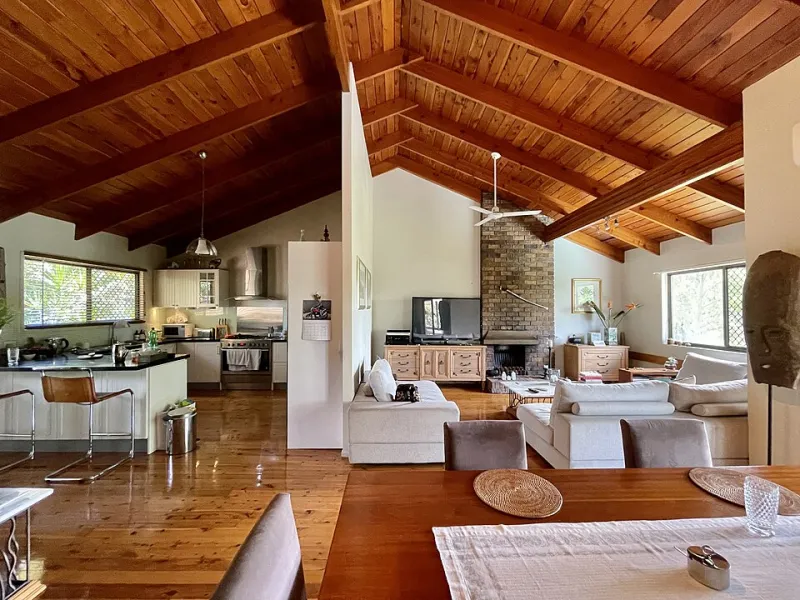
Photo: Kgbo, CC BY-SA 4.0, via Wikimedia Commons
Open-plan living sounds simple on paper: fewer walls, more room, better flow. In practice, it hands one wall palette a very long job description. The same surfaces have to sit behind a boiling pan, a dining table, a sofa and — in plenty of British homes — a desk with a laptop on it. Get it right and the space feels calm and generous. Get it wrong and it feels like three rooms have been pushed together and told to get along.
Start with the view, not the colour card
Before you open a single tester pot, stand at the furthest point of the space and look towards the kitchen. That sightline is what your scheme has to cope with every day. In a Victorian terrace with a through-lounge, it might be a long run from the front bay to the back extension. In a 1930s semi, it could be a shorter hop from the hallway door to the patio doors. Either way, the eye is travelling a fair distance, and busy colour changes along that route will chop the room into pieces.
The usual answer is a single background colour for the bulk of the walls, then one or two supporting tones used with intent. Three base colours is usually plenty in an open-plan space. More than that and the room starts to feel like a paint chart rather than a home.
Let the kitchen anchor the scheme
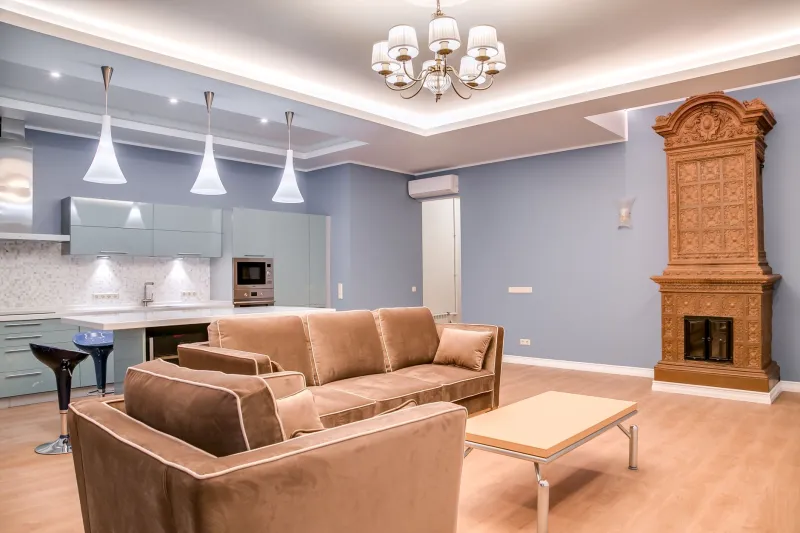
Kitchens are the hardest-working corner of an open-plan room, so it helps to treat them as the anchor. If your cabinets are a definite colour — deep green, navy, a warm grey — pull a paler version of that tone onto the surrounding walls. If the kitchen is mostly white or pale wood, choose a wall colour with a similar undertone rather than fighting it. A cool grey wall next to creamy cabinets can make the cabinets look grubby; a warm off-white can make brilliant white units look stark.
This is also where finish matters. In a kitchen zone, washable emulsion or a durable eggshell on the walls is worth the extra few pounds. You do not need to paint the whole open-plan space in scrub-friendly paint, but the bit behind the bins and the toast-making area should be able to take a wipe.
Give the middle bit a job
The dining table often sits in the awkward middle ground: not quite kitchen, not quite lounge. Rather than leaving it as a colour no-man’s-land, give it a deliberate treatment. A slightly deeper tone on the wall behind the table can make that zone feel intentional, almost like a room within a room. It also frames the table when you walk in.
If the dining area is short on natural light, resist the urge to go darker just for drama. A mid-tone with a warm base — clay, ochre, soft olive — will hold its own without turning the corner into a cave. Keep the ceiling and trim light so the space still breathes.
Put the strong colour where it earns its keep
Strong colour in open-plan rooms works best when it has a clear home. An alcove beside the sofa, a chimney breast, the back of a shelving unit, or a single wall behind the dining table are all good candidates. These are places where the eye can rest, and where the colour reads as a decision rather than an accident.
What tends not to work is a strong colour on one long wall that runs from the kitchen to the sofa. It draws attention to the length of the room and can make the whole space feel narrower. If you want depth, use it on a shorter return wall or in a recess. Let the long walls stay quieter.
Long ceilings and awkward spans
Open-plan spaces often come with long ceiling spans, structural beams or the ghost of a removed wall. Painting these successfully is mostly about reducing visual noise. If the ceiling is a continuous white plane, keep it that way and let the walls do the talking. If there is a bulkhead or an RSJ, paint it the same colour as the ceiling rather than inventing a contrasting feature you did not ask for.
In rooms with especially high ceilings, carrying the wall colour onto the ceiling can soften the boxy feel and blur the edges. In lower spaces, the opposite usually applies: keep the ceiling pale and let the walls carry the colour. Do not paint a low beam dark unless you want to feel it every time you walk underneath.
Trim is your punctuation
Skirting, door frames and window reveals are the full stops and commas of a colour scheme. In a connected space, keeping trim consistent throughout helps the rooms feel related. Brilliant white trim can look crisp against stronger walls, but it can also create a hard line in a softer scheme. An off-white or a colour matched to the walls will make the space feel more fluid.
If you are painting the kitchen cabinets and the trim in the same room, get samples next to each other before committing. Two whites can look identical in the shop and completely different at 7am in your own kitchen.
Test the scheme in the actual light
Open-plan rooms have several light conditions in one. The kitchen end may be bright and cool; the sofa end may be shaded; the dining table may sit under a pendant that makes everything look yellow after dark. Paint large samples on the walls and live with them for a few days. Look at them in the morning, at dusk, and with the lamps on.
A colour that feels too strong at midday may be perfect at 8pm. A colour that looks elegant in the shop may go flat in a north-facing extension. Testers are cheaper than repainting a whole room, and they tell you things a colour card never will.
The goal is not to make an open-plan room look like a show home. It is to make it feel as though someone thought about how cooking, eating and relaxing share the same air. A calm background, one or two deliberate accents and a consistent trim colour will do more for that than any single fashionable shade.